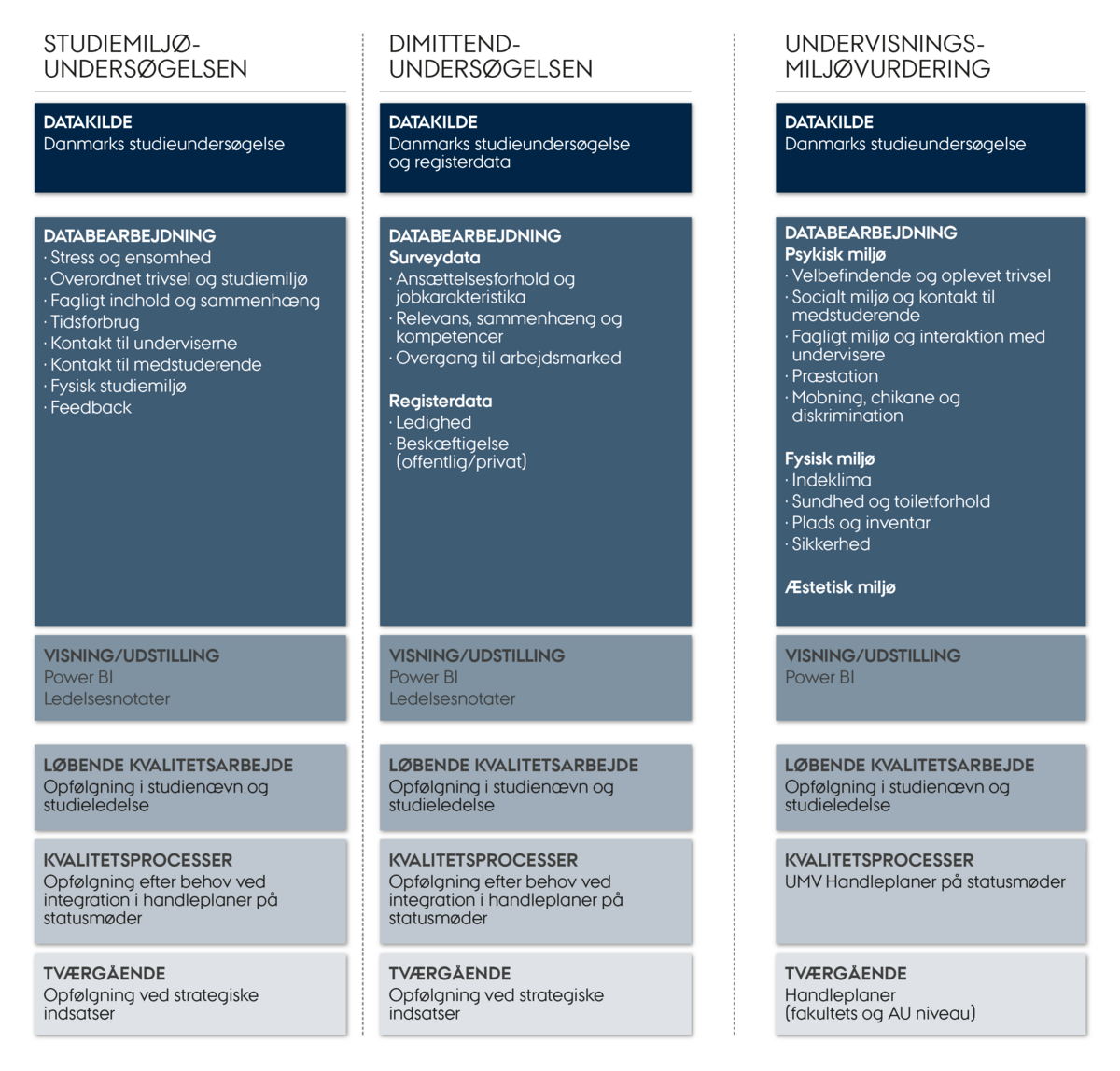
AU’s survey landscape consists of three recurring surveys that help shed light on our students’ and graduates’ experiences of various aspects of AU’s degree programmes. The three surveys are:
All three surveys are based on data from the questionnaire-based Danish Student Survey, a national survey conducted every other year among students and graduates of higher education programmes in Denmark.
The study environment survey is conducted every other year in the wake of the national survey. In the study environment survey, students’ responses are grouped into a number of themes based on selected questions, and the results are made available at degree programme, faculty and university level via AU’s PowerBI universe. A memo on the main results of the survey is also made available on the quality assurance website.
The survey results are discussed by all relevant committees, councils and boards at AU, see the process description, and the responses regarding the academic and social study environment and time use on the degree programmes also feed into three of AU’s quality indicators.
The graduate survey is conducted every other year in continuation of the national survey. In the graduate survey, the answers of graduates 1–2 years post graduation to questions related to the themes ‘Relevance, coherence and competencies’, ‘Transition to the labour market’ and ‘Most frequent work tasks’ are displayed in AU’s PowerBI universe.
The teaching environment assessment is a statutory survey of the physical, psychological and aesthetic environment surrounding the degree programmes. The survey is carried out every three years.
Through the three surveys, AU ensures that the students’ experience of their time at university, from the start of their studies until their first years in the labour market, is always included in the data informing the dialogue and follow-up on the quality of the degree programmes – both at degree programme and aggregated level.